
 |
|
“Your technique never ceases to amaze me. I've been a "rack 'em, crack 'em diversified adjuster forever and always leary of "instrument adjusting." I have to tell you, that since I started using your tech- nique and the integrator adjusting instrument, my insight scans have shown DRAMATIC improvement that I never saw with diversified adjusting. I have total confidence in this technique, and in my ability to correct sub- luxations and restore opt- imum function for my patients!"
-Dr. Kathryn Bennett "I am just writing to thank you for the powerful experience I had at your recent seminar… The seminar has had a huge impact on my life… I have been desperately search- ing and praying for answers to questions on both technique and phil- osophy. There were so many concepts and ideas presented that actually made sense." Dr.Jason Lupkes "I had a fabulous seminar with Steve. He gave 110%. It was real. It was
inspiring. It was life transforming. I had some people who were not really
sure about the pres- entation, at first, but they were won over and actively
involved in the learning process throughout the seminar. I would rec- ommend
this seminar highly for any purpose. Dr. TED Dear Dr. Steve,
I just want to send you a quick note: I bought you practice building package (Success Kit) at Total Solution in June and I have just finished reviewing the mc2 DVD's. Wow!! I have never seen results like this in my office! I have a patient with spasmodic torticollis that she has had for over 35 years, with one adjustment her friends and family members commented on how straight she looked and that they have can't remember seeing her ever like this before. I also had a patient that has been out of work due to taking so many medications for a chronic shoulder pain. Again, after one adjustment, he is completely off of his medications and back to work. The best thing about all of this is the certainty that we can deliver an adjustment and more so when not to deliver an adjustment.
As you said in your video: "I'm trading in the 81 Volvo", Porsche here I come!!!!!
With many thanks and gratitude,
Dr. Ron Robinson
|
MC2 Explained
|
“I thought you would like to hear this story. My sister-in-law last summer dev- eloped leaky spinal fluid syndrome. She has had raging painful headaches, the inability to walk, spine pain, and difficulty eating etc. After 6 or more MRIs, 3 different hospitals, UCLA Medical Center put some of her own blood put into her spinal fluid to plug the leaks (that’s how they explained it to her!) she began to slowly feel better. Two months ago the headaches were back with the spine pain. The neuro- surgeon at UCLA said they would have to attempt to remove each vertebra and look at the spinal cord to see if it was leaking, not much of a choice! She remembered me telling her about my new chiropractic procedures (MC2 Technic). The day after her first adjustment she called the office and reported ama- zing relief! She reduced her medication from 3 to 1 Oxycontin that day. She’s had two adjustments so far, and yes I’m excited and blessed to be able to help her. I forgot to mention that last summer when this all started I adjusted her and there was no response at all (diversified tech- nique). This is building incredible CERTAINTY in me about chiropractic again! Praise YHVH!” Dr Charles Jones D C. "I would also like to thank you for the adjustment that you gave me. Although you probably don't remember it, it was by far one of the best that I have had in m life. I have been adjusted since birth and truly know the difference between an adjustment delivered with or without that something special. I feel like I owe you a debt of gratitude. May all of the love that you give out come back to you exponentially!" "The MC2 DVD series has changed my practice to the better. I've already told you this, but the certainty which I now practice translates into better care for my clients, which I can do with greater speed (so I can see more who need care), and more love for clients and this profession. I feel more that "innate" is running the practice, and my clients feel the positive changes by the greater degree of health and wellness they feel, much more so than when I was adjusting the "high" spots. Thanks!" Dr. Jeff Donahue
|
|
|
Chiropractic techniques fit into 3 basic models based on the three body systems primarily addressed by chiropractors. Chiropractic intimately involves itself with the skeletal system, the muscle system and the nervous system. Therefore, while all chiropractic techniques involve all three systems, the techniques themselves can be differentiated from one another based on their method of assessment and their method of correction.
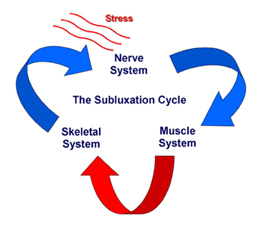
Segmental or skeletal system centered chiropractic techniques adjust vertebrae that are not in their optimum position back to a more normal position and, in so doing, affect the nervous system first and then the muscle system next. Postural or muscle system centered chiropractic techniques first involve putting tension or relaxation within the muscle system in order to allow an easier structural adjustment to take place. In so doing, this approach involves the muscle system first which then affects the skeletal system and then, finally, the nervous system. Tonal or nervous system centered chiropractic techniques are not muscle or bone based but rather focus on the nervous system and the related changes in a person’s physiology. As such, tonal chiropractic techniques look at the nervous system first and the doctor’s input into the nervous system then affects the muscle system which, in turn, affects the skeletal system. Since all three technique models work and produce good results, why would we prefer a tonal approach? The answer comes in understanding how the interference to a person’s nervous system takes place to begin with. Did the bone move out of place thus affecting the nerve which then affects the muscle? Bones cannot move by themselves so there must have been a muscle imbalance first. Did the muscle imbalance occur first thereby causing the bone to move out of its normal position? Muscles do not think or act on their own so a muscle imbalance can only be the result of an unbalanced nerve supply to the muscles. So, the bone can only move if a muscle moves it and a muscle will only move when the nervous system tells it to. For us then, it makes more sense to address the nervous system first so all else can follow. |
|||
 |
||||